
Tympanometry (Middle Ear Test) in Gangnam, Seoul
Medically reviewed by Dr. Kim Yoo Suk, MD · Board-certified otolaryngologist · Former professor, Yonsei & Ajou University · Consultations in English
QUICK ANSWER
Tympanometry is a quick, painless test that measures how the eardrum moves in response to changes in air pressure. At Gangnam Yonsei ENT in Gangnam, Seoul, it helps detect middle ear fluid, Eustachian tube dysfunction and eardrum perforations, with results explained in English by Dr. Kim Yoo Suk.
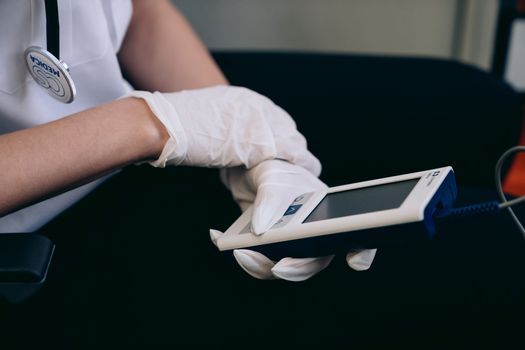
What is tympanometry?
Tympanometry is an objective test of middle ear function. A soft probe placed in the ear canal changes the air pressure slightly while emitting a tone and measuring how much sound bounces back from the eardrum. The result is a graph called a tympanogram, which shows how mobile the eardrum is and the pressure at which it moves best. Because it does not require you to respond to sounds, it is useful for adults and children alike. Some devices also test the acoustic reflex, a tiny muscle response to loud sound that adds information about the hearing pathway.
Common tympanogram types
- Type A: normal pressure and mobility.
- Type B: flat curve, suggesting fluid behind the eardrum or, with a large ear canal volume, a perforation.
- Type C: negative pressure, typical of a poorly ventilated middle ear.
Who is it for?
- A blocked or full ear after a cold, suggesting otitis media with effusion
- Eustachian tube dysfunction and airplane ear
- Suspected eardrum perforation
- Conductive hearing loss on an audiogram
- Follow-up after ear infections or a myringotomy
How it is done at our Gangnam clinic
Dr. Kim Yoo Suk is a board-certified otolaryngologist and former assistant professor at Ajou University School of Medicine. He treats all ear, nose and throat conditions, and his rhinology expertise is particularly relevant because the Eustachian tube opens into the back of the nose; nasal allergy, sinusitis and enlarged adenoids can all impair middle ear ventilation.
- The ear canal is checked with an otoscope or endoscope; wax may be removed first.
- A soft-tipped probe is placed gently in the ear canal to create a seal.
- You stay still and quiet for a few seconds while the pressure sweep runs. You may feel slight pressure.
- Both ears are tested, and the results are reviewed with your hearing test.
After the test
No recovery is needed. Results help decide whether to observe, treat an underlying nasal problem, use medication, perform autoinflation exercises, or consider drainage. In adults with persistent one-sided fluid, Dr. Kim examines the nasopharynx with nasal endoscopy to exclude a mass blocking the Eustachian tube.
Risks and limitations
Tympanometry is safe and painless, though it is postponed if the ear canal is very inflamed or after recent ear surgery. It does not measure hearing itself, and earwax, movement or talking can distort results. A normal tympanogram does not rule out inner ear problems. Seek prompt care for severe ear pain, discharge with fever, sudden hearing loss or facial weakness.
Practical information for foreign patients
Ear pressure after long-haul flights is a common reason visitors seek care in Seoul. Tympanometry and audiometry are usually completed at the same visit, and results are explained in English. Copies are available for insurance. See location and hours, the ear clinic overview, and Dr. Kim's background.
Frequently asked questions
Does tympanometry hurt?
No. A soft probe sits at the entrance of the ear canal and changes air pressure slightly for a few seconds. You may feel brief pressure, similar to a plane descending, but there is no pain. Both ears take only moments.
What does a flat tympanogram mean?
A flat, or Type B, tympanogram usually means the eardrum is not moving normally, most often because of fluid behind it. If the measured ear canal volume is large, it may indicate a perforation. Dr. Kim interprets it with your exam.
Can a blocked nose cause ear pressure problems?
Yes. The Eustachian tube connects the middle ear to the back of the nose. Allergic rhinitis, sinusitis or a cold can swell its opening, causing negative pressure, fullness or fluid. Treating the nose often helps the ear.
Your doctor
Dr. Kim Yoo Suk, MD
Board-certified otolaryngologist (ENT). Former clinical assistant professor at Yonsei University and assistant professor at Ajou University School of Medicine. Nose & sinus subspecialist who treats all ear, nose and throat conditions.
Consultations in English. Guide for international patients →
Visit us in Gangnam
2F HS Tower, 703 Seolleung-ro, Gangnam-gu, Seoul
Gangnam-gu Office Station (Line 7 / Suin-Bundang), Exit 3-1
Mon, Tue, Thu, Fri 9:00–19:00
Wed 14:00–19:00 · Sat 9:00–14:00
Closed Sundays & public holidays
Related pages
This page is general medical information written and reviewed by an ENT specialist. It is not a diagnosis or a guarantee of results; every treatment carries risks, and suitability is decided only after an examination. In an emergency in Korea, call 119.